Table of Contents
Introduced from the review
Overview
For those
Three indicators of facial treatment
important point
Introduced from the review
Thank you very much.
Here are some excerpts from a survey of those who received the trial version.
Although the effects vary from person to person, both of the two examples below are the impressions of a single treatment that you have experienced.


“I thought it would be a treatment that could be overridden, not a treatment that only gets better at the time and then goes back to normal after a little while...”
“The muscles in the area of the largest spots on the face.
I had been concerned for some time that I wasn't moving at that particular spot, but you were able to fix the stiffness of the muscles in that area, little by little, carefully and precisely.
As a result, the overall facial circulation is better, the skin looks better, and the spots seem to have faded a bit.”
Overview
To improve the skin's beauty to the bottom line, it relaxes the tension and rigidity of all tissues that make up the face and promotes the skin's metabolism.
The most significant feature is that it can relax a wide range of areas, including facial bones, cranial sutures, temporomandibular joints, and dura mater, which is impossible with massage.
It is recommended for those who want to maximize the potential of their skin at this point in time and highlight the beauty of the basic parts of their skin while promoting health.
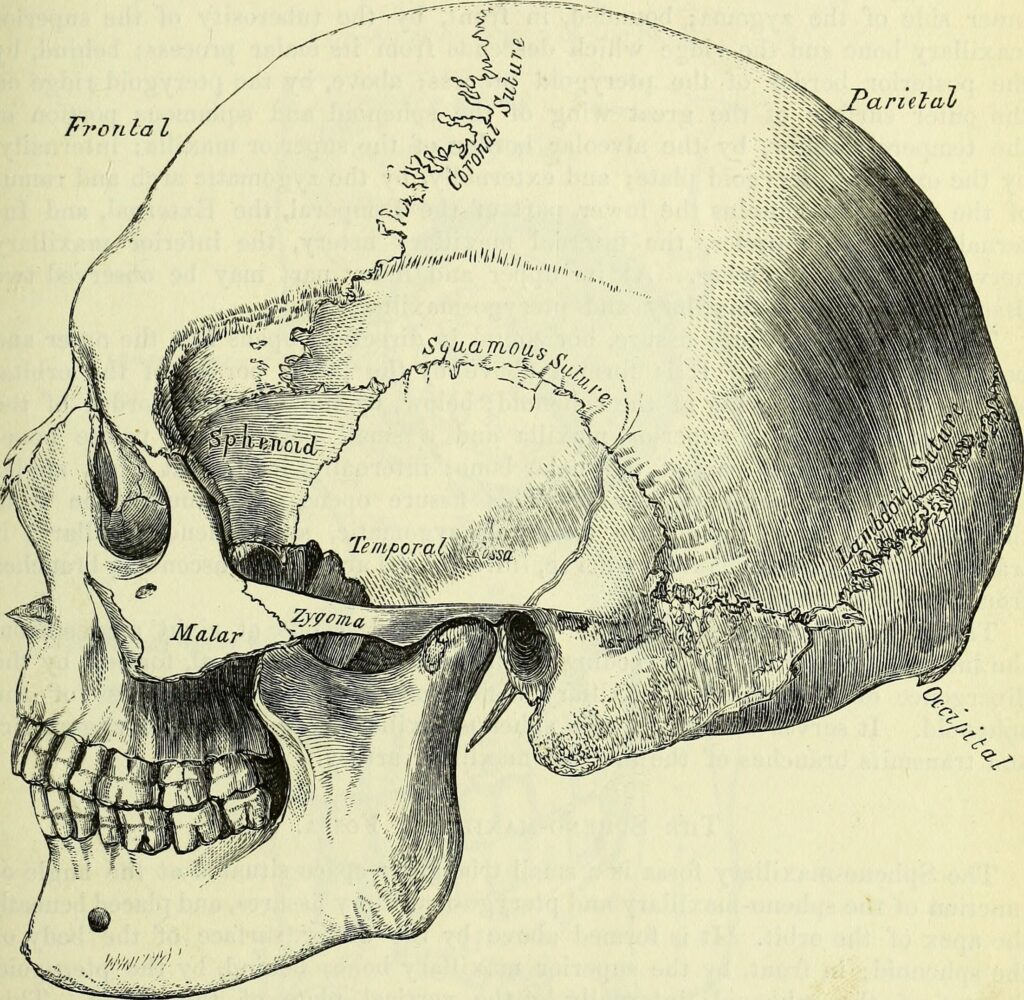
(From Wikimedia Commons ”https://commons.wikimedia.org/wiki/File:Anatomy,descriptive_and_surgical(electronic_resource)(1860)(14761483511).jpg”)
target group
-Those who wish to maximize the potential of their skin
-Eye strain
-Eyebrow pain, autonomic and trigeminal headaches, etc.
-Nasal congestion (e.g., sinusitis)
-TMJ problems (clenching, imbalance, etc.)
-Facial distortion
-Problems around auditory organs such as tinnitus
-Other facial problems
Three indicators of facial treatment
Here are three important anatomical points.
1. eyes and nose
The area around the eyes is extremely important as a pathway for facial blood circulation.

(From Wikimedia Commons ”https://commons.wikimedia.org/wiki/File:Anatomy,descriptive_and_surgical(1887)_(14762670651).jpg”)
Blood that has accumulated waste products due to eye strain is drained through the surface of the face and the cranium.
Hence, the emphasis here will be on the orbital and nasal areas.
The condition of the frontal bone, ethmoid bone, lacrimal bone, sphenoid bone, palatine bone, nasal bone, and maxillary bone that make up the orbit and nasal cavity are checked and treated.
Treatment in this area is effective for eye conditioning as well as eye strain and nasal congestion.
2. chin and cheeks
Next, we will focus on the temporomandibular joint.
The jaw area is an area that is very prone to left-right differences, and the load can easily accumulate due to teeth grinding, clenching, and chewing habits, which can greatly contribute to facial balance distortion.
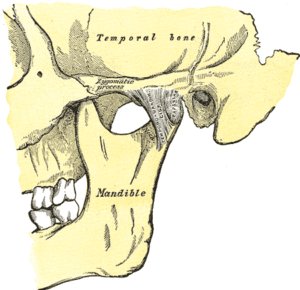
(From Wikimedia Commons ”https://commons.wikimedia.org/wiki/File:Gray309.png”)
Anatomically, the masseter muscle, a powerful muscle for chewing, and the muscles that connect the inside of the mandible to the cranium (external and internal pterygoid muscles),
Muscles that are difficult to apply treatment techniques also have a significant impact on the TMJ.
The pterygoid muscle is also located in the drainage pathway from the back of the eye to the cranial area (sea vein sinus → pterygoid venous plexus) and is a very important point in the fluid circulation of the face.
Using the stiffness of the TMJ and masseter muscles as one indicator, we perform treatment to optimize the condition of the TMJ area, including the zygomatic bone, which is easily affected by distortion in this area, and the mandible and temporal bone.
3. ear and temporal bone (facial nerve)
The ear and temporal bone area is a little further away from the face than it appears at first glance, but it is very important for facial conditions.
This is because the facial nerve, which controls the facial muscles, passes through the temporal bone and then extends to the face.
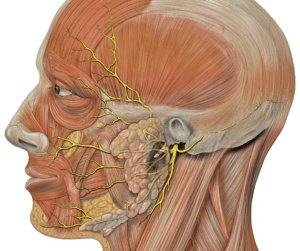
(From Wikimedia Commons ”https://commons.wikimedia.org/wiki/File:Head_facial_nerve_branches.jpg”)
Hence, in order to maximize the condition of the facial nerve, we will focus here on intraosseous lesions of the temporal bone (hardening of the bone itself), as well as the sutures and dura mater inside the cranium, starting from the ear.
Adjustments in this area have been shown to have some effect on tinnitus.
(*But since tinnitus itself can be caused by a variety of factors, the actual effect on the individual cannot be determined until the examination on the treatment is done. In some cases, there is no effect at all.)
important point
- Please come with the expectation that your makeup will fall off or be damaged by the treatment. In principle, the treatment is performed over a towel.
- If you have a chronic disease or any other physical symptoms at this time, "Facial only" treatment is not acceptable. (*To avoid risks due to imbalance of the entire body or priority issues. (*This is to avoid risks due to imbalance of the whole body or priority issues.)
- When considering the efficiency and effectiveness of the treatment, we recommend a normal overall adjustment first. This facial treatment is,Treatment Features PageThis is not an "irreversible treatment" in the sense described in Section 2.1. Therefore, the degree of retention of the treatment is higher and more effective after the major bias of the entire body has been eliminated by the overall treatment.
Kyoto Osteopathy
Seitai-Tanigawa
(on) a subscription basis
Closed: Wednesday and Thursday
Basic reception hours
Flexible hours from 9:30 a.m. to 8:00 p.m.
*We will make adjustments based on various circumstances. Availability for each date is as follows:Online Reservation SystemPlease check here.
Tel: (0) 050-3698-4890
Email: (English) contact@seitai-tanigawa.com

*When you make a reservation, we ask for the following information*.
(1) Name
② Contact Information (Phone Number, Email, etc.)
③ Location (Sanjo Karasuma / Iwakura)
(3) Preferred date and time *Range if possible (e.g., you would like to start between ____ and ____ on ____ day, etc.)
④ Desired treatment duration *Excluding the initial condition assessment
*In principle, we reply within 1-2 business days.
Also, please be sure to make an appointment before your firstPrecautions before making a reservation・Privacy PolicyPlease read the following.
*Please wear loose-fitting clothing with as little tightness as possible.
* We accept cash, credit cards, and some QR code payments.