Overview
Case Studies."Gastrointestinal issues."As noted on page 2, the treatment for gastrointestinal problems is simply to "soften the stomach".
However, we will explain on this page what specific organizations we are approaching and what effects we are aiming for.
The points to be loosened by the treatment can be roughly classified into three categories.
(1) Connective tissues supporting organs (peritoneum, mesentery, visceral support ligaments, etc.)
(2) Internal organs themselves (stomach, small and large intestines, etc.)
(iii) Vessels entering and leaving the organs (such as celiac artery and superior mesenteric artery)
Each of these will be explained.
(*If you would like to review examples of "gastrointestinal problems" treatmentthis way (direction close to the speaker or towards the speaker))
(1) Connective tissues supporting organs (peritoneum, mesentery, visceral support ligaments, etc.)
The ”environment” surrounding the organ is loosened. This is not the organ itself, but the surrounding environment, and this is the most important part of the technique.
This is because blood vessels, lymph, and other vessels of nutrition and excretion pass through these membranes and ligaments.
It can be thought that when the flow is stiffened and blocked, the condition deteriorates, and when it is softened and the flow is smooth, the organs can function better.
To give an example, the following figure shows the membrane that wraps the three red, blue, and green tubes from the back of the stomach pouch (entrance to the duodenum) to the liver.
This is the hepatoduodenal mesentery, which contains three very important ducts, the common hepatic artery, portal vein, and common bile duct, and is a frequent site for treatment.
The common hepatic artery is the blood vessel that nourishes the liver, the portal vein is the blood vessel that carries digested and absorbed products from the stomach and intestines to the liver, and the common bile duct is the duct that carries bile to the duodenum.
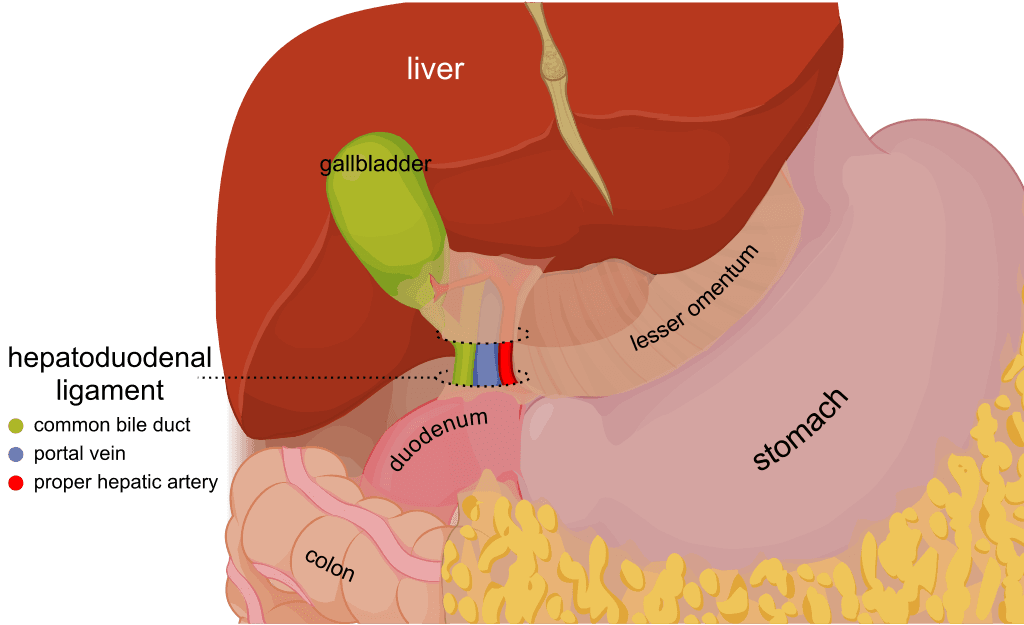
<The image from ”https://commons.wikimedia.org/wiki/File:Hepatoduodenal_ligament_EN.svg”>
Another point to make is that in the following figure, can you see the yellow membrane hanging over the small intestine?
It is a membrane called the mesentery. This is where blood vessels pass in and out of the small intestine (jejunum and ileum).
The diagonal line (from the right lower abdomen to the left upper abdomen) that supports this mesentery is called the mesenteric root, which is also the line of tension flowing from the right leg to the left shoulder, and is also a very important point in diagnosing tension connections throughout the body.
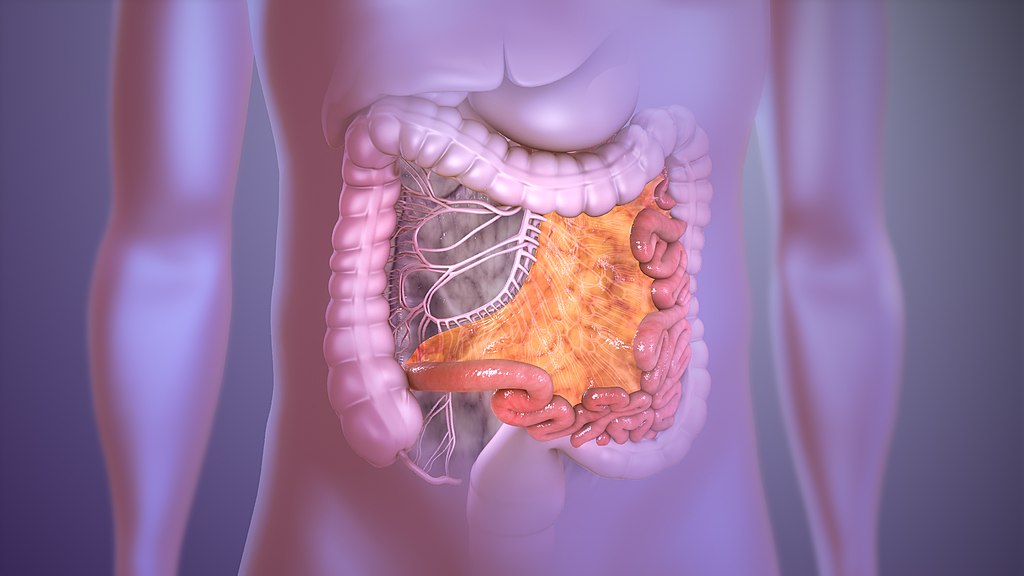
<The image from “https://commons.wikimedia.org/wiki/File:Mesentery_extending_from_the_duodenojejunal_flexure_to_the_ileocecal_junction..jpg ”>
One more point, the following image shows the ligaments that support the rectum.
This is a circular view of the abdomen, a perspective looking into the pelvic region from above.
From the bottom of the figure, there are three organs in a row: rectum, cervix, and bladder.
This ligament supporting the rectum is connected to the sacrum and is also interrelated with the sacral tension.
This is another very important point, and one that appears relatively frequently in the treatment.
This point is in the pelvis and cannot be directly touched, so the focus is loosened from the sacrum.

<From "Prometheus Atlas of Anatomy, Thoracic/Abdominal and Pelvic, 3rd ed.
(2) Internal organs themselves (stomach, small and large intestines, etc.)
The stomach and intestines are the main targets.
If there is a problem (stiffness), it can be captured by osteopathic membrane palpation techniques.
The stomach pouch is most often adjusted, and the small and large intestines are sometimes targeted. Many areas of the intestinal tract can be both palpated and adjusted. The rectum, for example, cannot be touched directly, so it is focused and loosened by tracing the membranes.
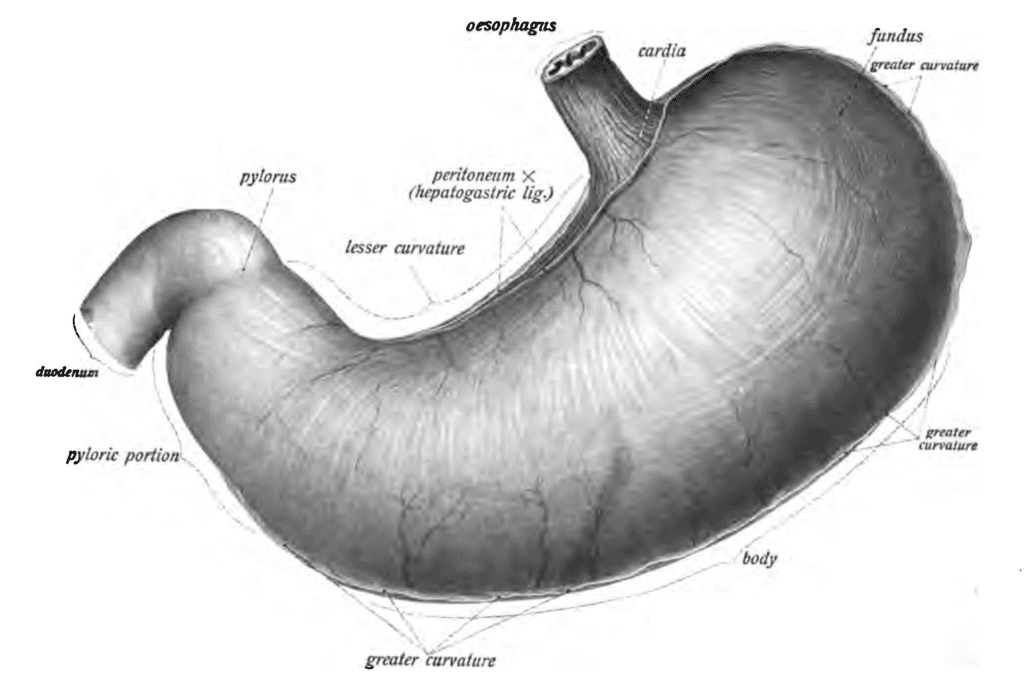
<The image from “https://commons.wikimedia.org/wiki/File:Sobo_1906_370.png”>
The figure below shows the ileocecal valve and the cecum (entrance to the large intestine, right lower abdomen).
The gastrointestinal entry and exit points are also prone to gather tension and often appear as treatment areas.
This area is an area where tension tends to gather relatively easily, because in addition to this ileocecal valve, it is a point that connects to the mesentery, which is connected to the mesentery, and to the mesentery shown above.

<The image from “https://commons.wikimedia.org/wiki/File:Gray1075.png”>
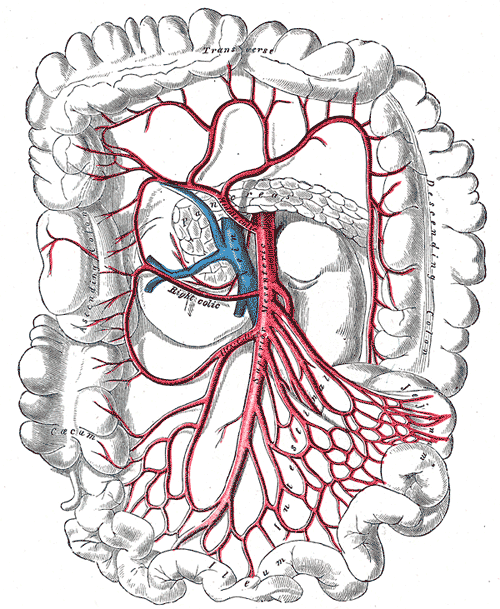
(iii) Blood vessels entering and leaving organs
①In some cases, tension appears along the artery, although there is some overlap with the connective tissue of the artery, and the tension may be released by targeting the artery.
For example, a place called the celiac artery, which divides into the stomach and liver, often appears as a treatment area.
It may also be adjusted by checking for tension on the running of the veins to maximize the function of the ailing organ.
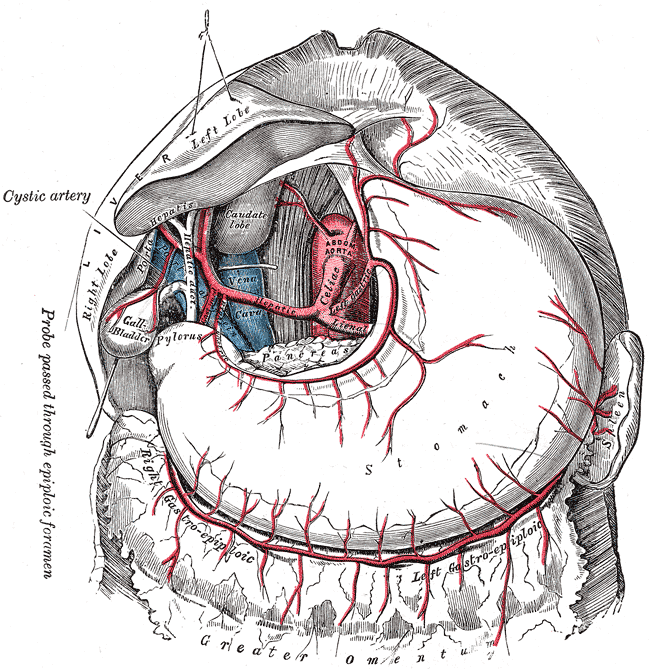
<The image from “https://commons.wikimedia.org/wiki/File:Gray532.png”>
<The image from ”https://es.m.wikipedia.org/wiki/Archivo:Superior_mesenteric_a.gif”>
When treating any of these points, the treatment is very soft and loosens with just enough pressure to softly place the palm of the hand or fingers.
We do not use forceful pushing or pulling techniques that may injure organs or blood vessels.
The methods, techniques, and concepts of the treatment arethis way (direction close to the speaker or towards the speaker)We hope that you will refer to the following information.
To review examples of treatments for "gastrointestinal problems," please see below.
Kyoto Osteopathy
Seitai-Tanigawa
(on) a subscription basis
Closed: Wednesday and Thursday
Basic reception hours
Flexible hours from 9:30 a.m. to 8:00 p.m.
*We will make adjustments based on various circumstances. Availability for each date is as follows:Online Reservation SystemPlease check here.
Tel: (0) 050-3698-4890
Email: (English) contact@seitai-tanigawa.com

*When you make a reservation, we ask for the following information*.
(1) Name
② Contact Information (Phone Number, Email, etc.)
③ Location (Sanjo Karasuma / Iwakura)
(3) Preferred date and time *Range if possible (e.g., you would like to start between ____ and ____ on ____ day, etc.)
④ Desired treatment duration *Excluding the initial condition assessment
*In principle, we reply within 1-2 business days.
Also, please be sure to make an appointment before your firstPrecautions before making a reservation・Privacy PolicyPlease read the following.
*Please wear loose-fitting clothing with as little tightness as possible.
* We accept cash, credit cards, and some QR code payments.